Showing posts with label sparkling in second. Show all posts

Thursday, October 22, 2015

Pumpkin Carving in 1st Grade

Hello friends and HAPPY FALL!

Jen from Sparkling in Second Grade here :)

We have been immersed in that pumpkin life in my classroom.

I wanted to share some ideas for carving pumpkins in first grade!

At first I thought it was quite a daunting task. In my 6 years of teaching, I had never carved a pumpkin in class. It sounded messy!

This year, I stepped out of my comfort zone because, well, my kids needed me to! All those questions and experiences that can come if I just get over the fact that I'm a control/neat freak and allow those little munchkins to learn and experience new things!

With a lingering pumpkin patch field trip on the horizon, I just knew we had to dig in to our own pumpkins.

Here are some tips to making it a clean and fun exploration!


Here's what you need:
*those cheap carving tools
*latex gloves
*garbage bags
*baby wipes
*cheap led light


The cheap carving tools (which I thought were dumb, but turned out to work WAY better than a knife) worked like a charm to take the top off.

While I talked and cut, my students were on the carpet labeling the parts of the pumpkin (cut/paste from A Year of Many Firsts).

I let me students help me dig out the seeds (and I wore the gloves). I lined them up and gave them a baby wipe after they got to dig some guts out. 

To clean up, I took the pumpkin off the stand, folded up the seeds, took of my gloves and was ready to move on! All while the students colored/cut/pasted their pumpkin parts. We left the rest for the next day (I had placed a new trash bag underneath the pumpkin for the next day).


We used A Teachable Teacher's Pumpkin Carving pack to guide us through as we determined how to cut our pumpkin into a Jack-o-Lantern (as well as a little inspiration from The First Grade Parade with our Jack-o-Lantern tally chart). 

We used the chart to guide us and everyone got a chance to draw their own faces. After we drew, everyone came to the carpet and we tallied up the shapes we used. To carve our class pumpkin, we used the most popular face shapes that were picked.
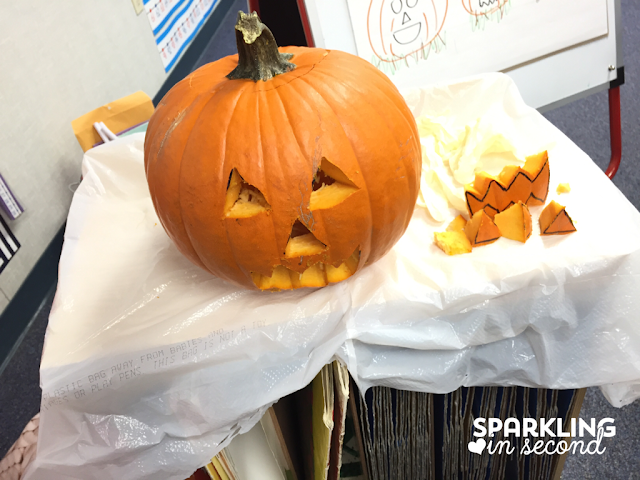

We stuck a cheap light inside and we had ourselves a Jack-o-Lantern!


BOO!

On the third day of this pumpkin extravaganza, we got to taste the seeds! *Note: I do love a freshly baked pumpkin seed, but I did not have time. I just picked some up from Trader Joe's.*

We took a survey before, what did we think it would taste like. Did a taste test and decided if we liked them!


After all this, our pumpkin was beginning to rot! GROSS!

My students asked what happens when it's done being a Jack-o-Lantern and I couldn't help but say, "Let's find out!"

I stuck some caution tape around him and set him outside our door in the dirt.


Now we will watch as he rots back into the earth.

I hope this inspires you and your students! I'd love to hear what you do to make carving easy and fun for your students!

Happy carving!

Saturday, September 19, 2015

Getting Comfortable with Common Core

common core, ccss, ccs, core standards

I am knee deep in Common Core Standards and curriculum. Most of us are completely despising our newest math curriculum and lack-there-of ELA curriculum. Last year, I taught BOTH Common Core and California Standards...at the same time. That was fun...

But if you are in a state that has chosen to adopt Common Core, this post is only here to "look on the bright side". Note: I am neither an advocate or adversary of Common Core, I am not here to promote a specific opinion or viewpoint, but my state has adopted it, it's here to stay for a while. I need to become a pro at it and accept it for what it is or I'll have to leave the field and I'm pretty unqualified for anything else :)

Intro to Common Core
The green states are the ones who have adopted Common Core {hey even some territories have}.

I'm sure you've seen this video on the Common Core website {which I now have to use religiously for all my lesson plans, etc.}, if not, take a second to watch it {it won't kill you...at least I think it won't...}.
I interpret the general purpose in Common Core is to lay the ground work for an equal education across the nation as well as try to raise the standards of education so we can compete with the world. Let's be honest, we aren't top of the class when it comes to comparing countries in education. Common Core's focus is that of higher achieving countries, numeracy and literacy on a deep level. 

3 x 4 = 11
You've probably seen FB posts floating around showing random math problems verifying that 3 X 4 = 11 or 2 + 2 = 5. Yes, I've watched, read, criticized, and shook my head at these ideas too, thinking, "oh my goodness what am I getting into?" But I think you need to be knowledgable in what you say before you speak out. 
I've learned two things over the past couple years as I've studied and taught Common Core. One, it's about explaining your thinking and reasoning. On the dreaded SBAC Performance Tasks {which I have taken myself & a quick note to all teachers: get your children computer literate NOW} a student can get an answer wrong, but if their reasoning supports their answer, they can get points! And if they get an answer wrong, but get the succeeding answers right, based off the wrong answer {did I lose you??}, they can still get points! Now I don't know if this is a good thing or a bad thing, but the point is: students must have reasoning for everything they do! So get your students explaining how they got what they got, in whichever way they got there.
The second thing I've learned is math.is.complicated.

Complicated Ways to Solve a Simple Problem
So are you coming across the extremely long, seemingly complex ways to solve math equations yet? 


I feel like I experienced these YouTube videos first hand! Each day I look at my lessons and think "Oh my gosh, how am I going to teach this? How are my students going to grasp this?" But let me tell you something, they get it! It's wild. Now I am in first grade, so those of you in the upper grades, you will have to wait a few years before your students likely go "oh yes, we've seen this before and we understand". Be patient! It will happen!
I have come to find, Common Core is not trying to make things more complicated {although by the looks of it, one could argue the latter}, but simply offering more ways to visualize and interact with numbers. It has not told us that we cannot teach them the "short cuts" or the "old ways", it has introduced us to different ways we can see numbers. Let me give you an example from my own classroom.
We spent the entire first 4 months of school making...dare I say...number bonds, breaking apart and putting together numbers to make 10. We are now using our knowledge of ways to make 10 to add and subtract bigger numbers. 
{this gave me a hard attack the first time I saw it too, adding to subtract?!}
My students are very successful in breaking down numbers into number bonds and making 10. Because of this, they were able to grasp this seemingly obscure technique to help them solve these bigger subtraction problems by using addition {let's face it, the only way I got the concept across to myself was to tell the kids they were solving subtraction the SUPER SPY WAY with addition-only spies use addition to solve subtraction ;)}. 
The more I teach these concepts, the more I see the similarities in how I actually mentally think and break down these numbers. It was more of a coping mechanism back then, rather than memorizing the answers. Now Common Core has taken our "mental maths", if you will, and added them to the bank of our students knowledge. In the end, you NEVER KNOW what will stick. Which strategy your students will pick, but we need to gear them with as many as possible to allow them to succeed.

Know Your Standards
The best advice I can give you is to read read read your standards. Familiarize yourself with each strand.
Look at the Appendices for Math and ELA for glossary of terms and strategies to teach. 
Once you feel proficient in your grade, check out the grade below you and above you. 
Most definitely read up on the Anchor Standards for ELA and the Common Core Mathematical Practices that tie everything together.
Change can be difficult, but don't throw out every resource you've ever had! Many things {not all} can be manipulated into reaching a Common Core goal. Look at your resources with a thrifty eye and see how you can still use what you have to assist these new standards.

Some Extra Resources
Here are some extra resources that can help if you are struggling to teach certain concepts:

Pick a specific standard by grade level and you are given ample resources to teach it!


The same goes for the math version, pick a specific standard by grade level and you are given ample resources to teach it!
This has been a helpful resource for glossary of terms as some of the terminology may be new to us in ELA.

***********************

Starting something new is ALWAYS hard. Especially when it looks so daunting, but I don't think it's meant to harm our students brains, instead it's here to give them more opportunities to succeed. We teachers do whatever it takes :) If we wait it out and try our best, each year it will get easier! First years of anything are TOUGH.
I feel bad for you upper grade teachers who have to wait til it filters though each year! Keep on going friends!

Also, be on the lookout for New ELD Standards, I know California is well on it's way of implementing some in the near future.

***********************
Again I am not advocating or opposing Common Core. I hope you feel encouraged and empowered from this post and know you are not alone! Please no aggressive comments :)

For Common Core Aligned Resources, check out my TpT store!


Thursday, September 3, 2015

Teaching First Grade Tips!

first grade, back to school, teacher tips, teaching advice

Hi friends, it's SEPTEMBER! School is back in session!

I saw an awesome post from Mary at Sharing Kindergarten about Kindergarten tips and I thought {and asked her permission} I could use it to start a "First Grade Teacher Tips" blog. So here are my 3 tips for a successful first grade classroom!


First graders have the attention span of a gnat {pretty sure I do too...}. This means you only have about 6 minutes to get your point across and MOVE ON. Thankfully, I'm a bit ADD myself, so if things are taking too long, I get bored {sometimes I have to entertain myself}. The rule of thumb is, kids have the attention in minutes as their age {example, if a student is 5 years old, he/she has a 5 minute attention span}. 

This does not mean you have to change subjects EVERY 6 minutes. BUT you as the teacher should not be talking solo for over that amount of time. Introduce concepts in small, understandable chunks. Once you've hit your time limit, get some practice in with activities or small groups {I know this doesn't work for EVERY lesson, sometimes you have to plow through ;)}.

I learned from the great Rick Morris {the king of classroom management}, one option is to set a timer, when it goes off, switch your activity. 

Small groups are wonderful. Their attention span tends to expand when they are working independently on what THEY want {or at least what they THINK they want to be doing, we teachers are great at making kids think they are choosing ;)}.

Catherine from The Brown Bag Teacher is the queen of small group Daily 5. You should most definitely check her posts out!


Set high-measurable expectations. Your students WILL meet them! If you only expect them to write one sentence, that's all they will write. How should they act in the classroom, how should they respond when they are upset, what does finished work look like, what does my teacher expect me to do during this time? Push your students, they need you to expect much from them! We all know you believe in your students! Expect much of them, and they will exceed your expectations.

{disclaimer: I know there are some outliers in our first grade classrooms, but some of them will not test your boundaries if you set your expectations early and strong}


This is likely a no-brainer, but entertain, entertain, ENTERTAIN. I am the silliest of silly teachers. Not all first grade teachers are and that is perfectly fine! For me though, sometimes I just have to sing a song, talk in an accent, or dance-because some things I teach are BORING and I just can't make them exciting. Thankfully Teachers Pay Teachers and Teacher Bloggers have made it a little easier to think of those crazy entertaining ideas. Ya'll, we are competing with cartoons, iPhones, etc! Step up your game ;)

Here are a couple examples of making everything engaging for FREE {and it doesn't take much effort either}:


first grade, back to school, teacher tips, teaching advice
{this is a great pinning image ;)}

Do you have some simple {& easy to implement} tips for teaching first grade? Leave them in the comments :)

Happy first days of school!