
Hello, everyone! I'm thrilled to be a part of this fantastic group of first grade teachers/bloggers/collaborators! I am Lesley Boatright, and I run the TpT shop Practice Makes Perfect. I've been a teacher for a really long time. I taught kindergarten for 10 years, and then switched to first grade and never looked back. I love teaching first grade! I love teaching math and reading and social studies and Spanish. When I'm not teaching, I'm wife to my supportive husband, and mother to my two children. My oldest son, 20, is in the service and living with his wife in North Carolina. My daughter, 11, is in fifth grade, and often models for my resources, especially in the summer or if I want to include a face. We've worked out a deal where I pay her $1.00 per resource sold if she models for it.
.jpg)
Supplementing the Text
Teaching
social studies is always a challenge for me.
Being in a smallish Catholic school, there is a limited textbook budget,
and it seems like every time it's time to upgrade the first grade social
studies books, the money runs out. The
copyright date on the books I currently use is 2003!
I
have no problem with the text. It's a
perfectly good text, and the information for first grade probably hasn't
changed all that much that we need to get new books every five years like we do
in reading and math. But we no longer
get any supplemental materials that come along with the texts, so we're left to
our own devices as to how we want to teach the objectives. So I was thrilled to find these
two little books from Hameray Publishing's My World series, What's a
Community and Very Important People.
I knew they tied in nicely with the social studies objectives.

I
started with What's a Community?.
Using the posters I made to accompany the book, I started by introducing
the key vocabulary from the book.


Then
I read the story and we discussed all the different communities of which we are
a member. We made an anchor chart on big
paper as we talked about our communities.
After
that, we talked about our place in the world, starting with our
neighborhood. From there, we discussed
that our neighborhoods were all a part of our town (city, if you live in an
urban environment). We went on to say
that our town (city) is a part of our state, our state is a part of our
country, and our country is on the continent of North America. We completed this little foldable booklet to
reinforce what we learned.

After we completed the foldable, I guided the children through completing a craftivity to again reinforce what we learned about our place in the world and hung them in the hallway.


and others -- well, let's just say it's a good thing we wrote the name as well as the picture!


I love reading The Little House, by Virginia Lee Burton, as part of my social studies unit on communities.
It is a great example of rural, suburban, and urban. I created this little flapbook to finish after reading the story to my children.


You can tell by reading the tabs the children are meant to make illustrations that depict what each type of community environment looks like. A quick glance at the finished product, and you can tell whether your students understand the differences between the types of community environments.
After reading Very Important People, I made this fun Community Helpers puzzle booklet. The children, or you, read the description, than cut and glue the correct community helper to the page.

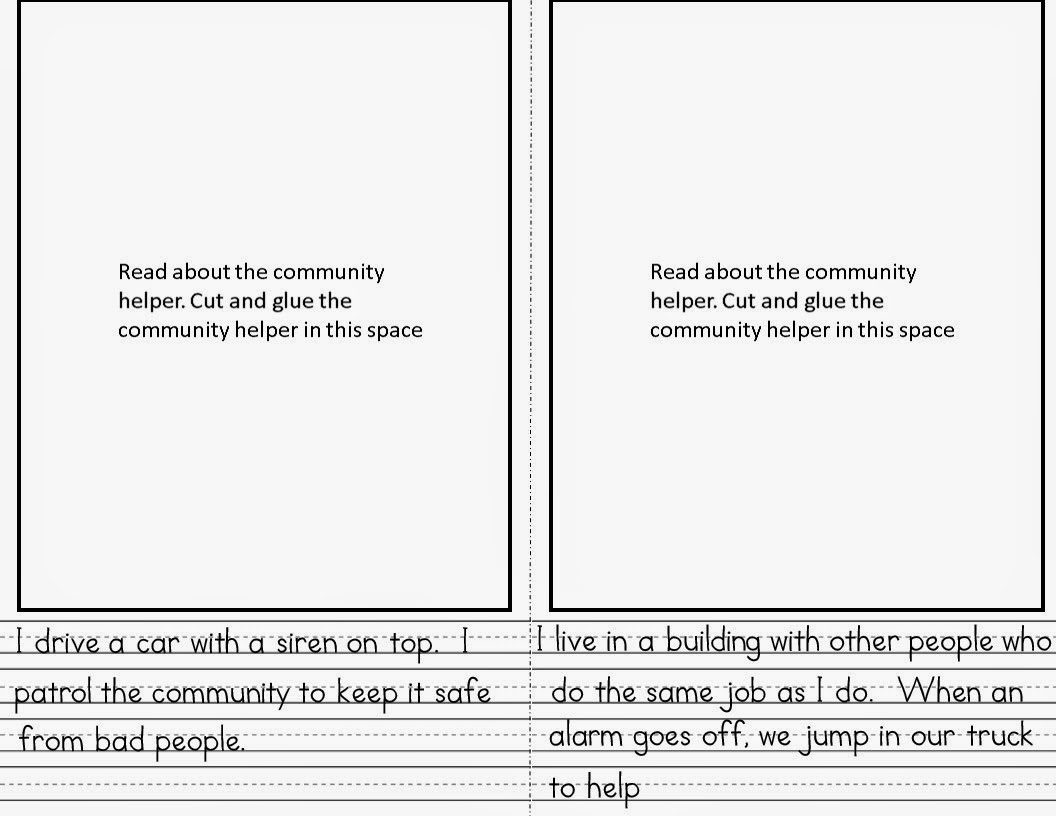

My kids loved completing this puzzle booklet. The reading was easy enough that, working in groups of 3 to 4, most of the children were able to independently read the text, and if they got stuck on a word, they were able to help each other. They loved the feeling of working independently and completing the booklet, then taking them home to share with their families.
So that is a closer look at how I used this social studies unit in my classroom. It's a great way to meet the objectives in first grade social studies in a relaxed and engaging way! If you'd like to take a closer look at the resource and download the free sample included in the preview, you can click on the picture below.

Have a great weekend, everyone!
